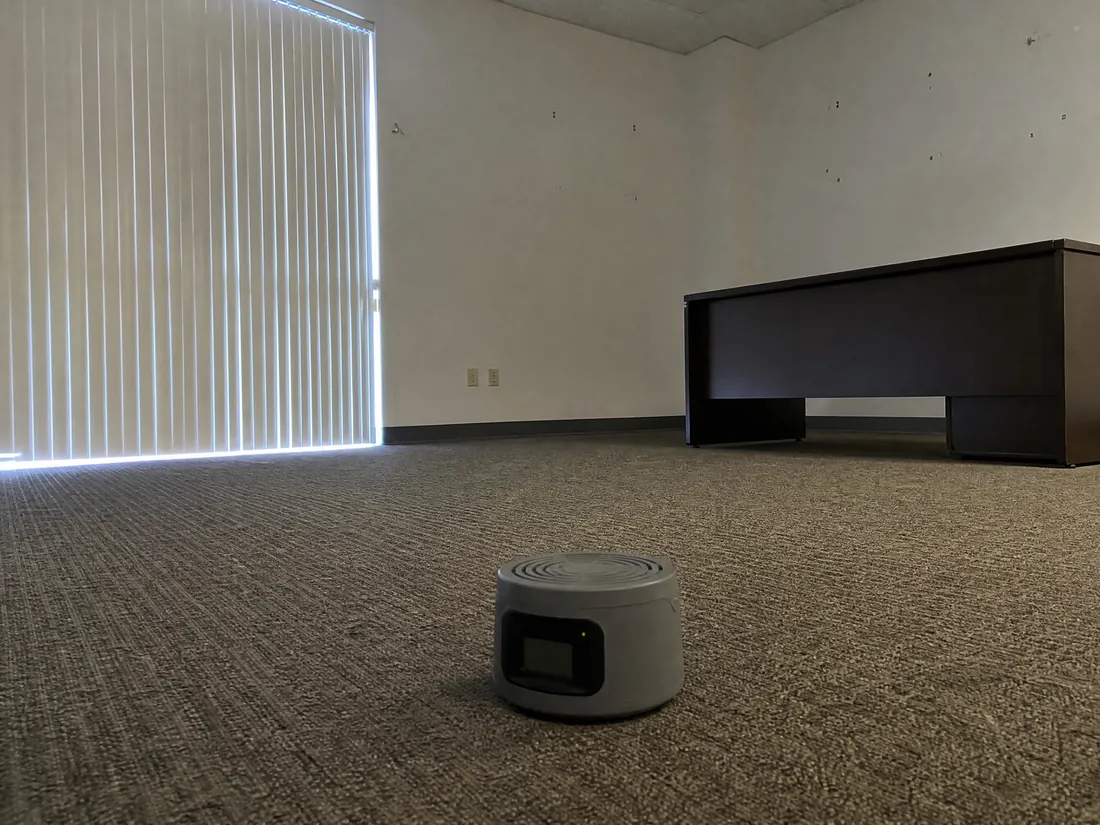
How Many Devices, and Where
Device count follows the standard, not convenience. Measurement in large buildings places detectors in ground-contact rooms that people occupy, in frequently used spaces on the lowest occupied level, at defined density rather than one per floor. In multifamily the count is driven by ground-contact units and building count, which is where the various agency policies come in.
Rooms we always cover: ground-floor offices and classrooms, ground-floor units, break rooms and lounges on slab, below-grade storage that staff occupy, and any room where the slab has been penetrated for a sump, a pit, or a trench drain. Rooms we skip: unoccupied mechanical spaces, closets, and anywhere nobody spends hours.
Which Device for Which Job
| Device | Duration | Best for |
|---|---|---|
| Continuous radon monitor (CRM) | 48–96 hours | Transactions, deadlines, anything needing hour-by-hour data and tamper detection |
| Charcoal canister | 2–7 days | High device counts where budget matters more than resolution |
| Alpha track | 90 days to 1 year | Long-term occupant exposure questions, post-mitigation monitoring programs |
We default to continuous monitors on anything commercial. They record hourly, so if a tenant props a door for eight hours we can see it in the data rather than arguing about it afterward.
Closed-Building Conditions in a Building That Cannot Close
Here is the part that gets ignored. Valid short-term testing requires closed-building conditions: exterior doors and windows shut except for normal entry and exit, HVAC operating normally, no whole-building ventilation changes, for 12 hours before and throughout the test.
In a school or an office that is achievable with a memo. In a 1970s apartment building in Van Nuys in September, when every tenant is running windows open because the wall unit is loud, it is not. Our approach is to test what is real: we document actual conditions, use continuous monitors so anomalies are visible, and in borderline cases we recommend a longer-term device instead of pretending a two-day snapshot represents the year.
Turnaround and Reporting
Continuous monitor results are available the day devices come out; the written report follows within two to three business days. Rush turnaround for a closing is possible and we do it regularly, but tell us the date at the start rather than on day three.
Every report includes device serial numbers and calibration dates, deployment and retrieval times, room-by-room results with the location identified in a way a stranger can find, documented building conditions, the protocol followed, and a signature from a CDPH-listed measurement professional. That last item is the one lenders check.
What Happens If Something Reads High
Two paths. If a single space reads modestly above 4.0 pCi/L and the deadline allows, a confirmatory test is often the right move, because a single short-term result can be knocked around by weather, HVAC changes, or a propped door. If multiple spaces read elevated, or the deadline does not allow a second round, we move to diagnostics and mitigation.
What you should not do is nothing. An elevated result sitting in a file with no follow-up is worse for you legally than not having tested, and it will absolutely surface during the next transaction.
Cost
Small commercial buildings usually run $650 to $1,800 for a full test depending on device count and turnaround. Multifamily is priced per unit tested, generally $45 to $110, with the per-unit price dropping as the count rises because deployment and retrieval happen in one mobilization either way. Post-mitigation verification tests are typically $350 to $700.
Questions About This Service
How long does a commercial radon test take?
Two to four days for a continuous monitor test, which is what we use for anything on a deadline. Add two to three business days for the written report. Long-term alpha track testing runs 90 days or more and is used when someone needs an annual average rather than a snapshot.
Can you test with tenants and staff in the building?
Yes, and that is how most commercial testing is done. What matters is documenting the conditions honestly.
Who is allowed to perform commercial radon testing in California?
Anyone offering professional radon measurement services in California must be listed by the California Department of Public Health, which requires NRPP or NRSB certification and recertification every two years. For a lender-driven test, also confirm the person signing the report holds the measurement credential rather than just the company holding it somewhere in the org.
Do you provide the report our environmental consultant needs for a Phase I?
Yes. Our reports are formatted for exactly that use: protocol named, devices and calibration documented, conditions logged, results by room, signed. We work alongside environmental consultants on due diligence constantly and can deliver directly to them if that is faster.
What does a commercial radon test cost in Los Angeles?
Small commercial buildings generally run $650 to $1,800. Multifamily is $45 to $110 per unit tested, dropping toward the low end at higher unit counts.
Is testing required by law in California?
No. California has no statute requiring radon testing in commercial buildings or rental housing. The requirements that actually bite are contractual and federal: agency and lender loan conditions, HUD program rules, district or corporate policy, and purchase agreements. See our lender requirements page for how those work.
Working against a closing date? Tell us the date first and we will build the schedule backward from it.
Call (213) 845-6500