Why Los Angeles Has This Code
On March 24, 1985, methane migrating from the Salt Lake Oil Field accumulated beneath a Ross Dress for Less store in the Fairfax District and exploded, injuring more than 20 people and prompting nearly two decades of regulatory work. Ordinance 175790, adopted in 2004 and codified as Division 71 of the Los Angeles Building Code beginning at Section 91.7100, is the result. It was revised in 2012 to expand coverage and tighten testing.
The city sits on oil. Salt Lake, Las Cienegas, Wilmington, Inglewood, and a long list of smaller fields, plus abandoned wells whose locations are tracked through CalGEM records. That geology is also why parts of LA have soil gas issues at all.
Zone, Buffer Zone, and How to Check
The methane zone covers areas with confirmed methane presence: near active and abandoned wells, tar seeps, and landfills. The methane buffer zone extends beyond it to account for lateral gas migration through soil. Both trigger mandatory testing.
Check any address on ZIMAS, the city's Zone Information and Map Access System. ZIMAS is the authoritative source for an individual property, and it supersedes reading the zone map by eye, which is a genuinely bad idea near a boundary. If ZIMAS says no, LADBS will not require methane mitigation, though DTSC may still have something to say if the site has contamination history.
The Five Site Design Levels
Your soil gas test produces two numbers, methane concentration in parts per million by volume and gas pressure in inches of water column, and those two numbers assign a Site Design Level that dictates every required component.
| Level | Roughly when it applies | What gets required |
|---|---|---|
| I | Below 1,000 ppmv, pressure at or below zero | Membrane barrier, gravel blanket, passive sub-slab vent system |
| II | 1,000–50,000 ppmv under 2 in WC, or low concentration with positive pressure | Level I plus tighter barrier spec and ventilation of the lowest occupied space; deputy inspector required |
| III | 50,000–300,000 ppmv, or proximity to an abandoned well | Mechanical ventilation, methane sensors, alarms; custom design mandatory, standard plans not permitted |
| IV | Pressure above 2 in WC with 1,000–50,000 ppmv | Continuous mechanical sub-slab depressurization, redundant alarms |
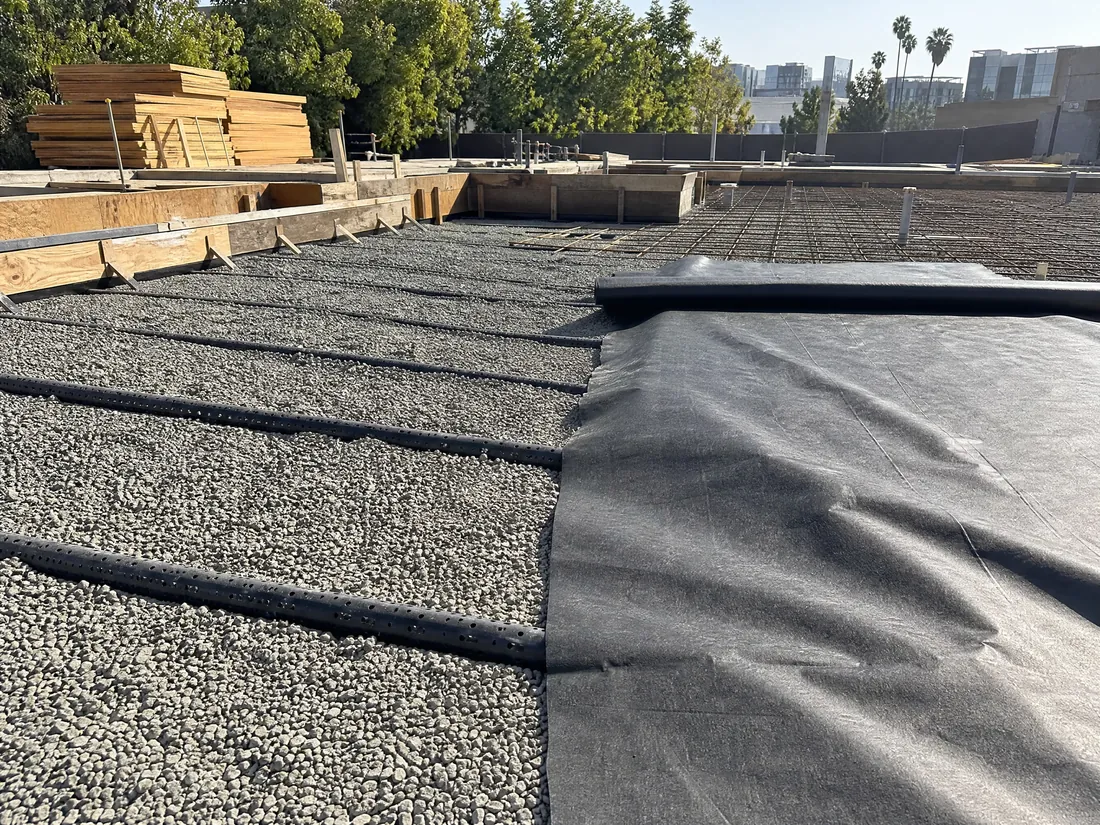
| V | Above 300,000 ppmv, or 50,000–300,000 with pressure above 2 in WC | Everything: continuous barrier, SSD with perforated pipe and gravel blanket, risers, mechanical exhaust, sensors, alarms, trench dams at utility penetrations |
Standard Plans Versus Custom Design
LADBS publishes methane standard plans, and they are tempting because they look free. They are appropriate for simple slab-on-grade projects at Levels I and II with no below-grade features, and the plan checker has discretion regardless.
Where they fail: no project-specific detail for irregular footprints or sloped lots, no LARR-approved product specification, and insufficient direction for the crew in the field. Industry experience puts the correction-notice rate on standard-plan submittals around 40%, and a correction cycle adds weeks. On anything with a subterranean garage or basement, custom design is effectively mandatory anyway because below-grade construction introduces horizontal migration paths and waterproofing coordination that standard plans do not address.
The Deputy Inspector
At Site Design Level II and above, LADBS requires a methane deputy inspector, a third-party quality control role independent of the contractor, and at Level I the plan checker can require one at discretion. The GC hires them; the cost passes to the owner.
What they verify during construction: barrier thickness by cutting coupon samples roughly every 500 square feet and measuring with a caliper against the 60-mil minimum, smoke testing of seams and penetrations for gas-tight integrity, gravel blanket depth, perforated pipe installation, and vent riser routing and termination. They must be present during barrier installation.
A failed thickness test means re-application and a re-test, which costs at least a full day. This is why we do our own coupon checks before calling the deputy out, and why we do not let a crew install barrier on a windy day when the material will not lay flat.
Timeline and What It Costs
Soil gas testing runs one to two weeks. Design takes two to four weeks depending on complexity. LADBS plan check adds two to six weeks, with expedited review available for a fee that can cut it to one or two. Budget six to twelve weeks from testing to approved plans, then construction.
System cost scales hard with Site Design Level. A Level I system on a small commercial building might be $4 to $7 per square foot of slab. A Level V system with mechanical depressurization, sensors, alarms, and trench dams can run $18 to $30 per square foot, plus deputy inspection fees. Get the soil gas test done before you finalize a construction budget, not after.
Questions About This Service
How do I find out if my property is in a methane zone?
Look the address up on ZIMAS, the Los Angeles Department of City Planning's zoning database. It reports methane hazard classification and is the authoritative source for an individual property, ahead of reading the printed zone map. Buffer zone status triggers the same testing requirement as the methane zone itself.
Do all Los Angeles construction projects need methane mitigation?
No. Only projects within LADBS-designated methane zones or buffer zones, which is roughly a quarter of the city's land area. Properties outside those areas can still face requirements if contamination is identified in a Phase I or Phase II assessment, in which case DTSC usually takes the lead instead of LADBS.
What is a methane deputy inspector and do we need one?
An LADBS-approved third-party inspector, independent of the contractor, required at Site Design Level II and above and discretionary at Level I. They verify barrier thickness with coupon samples, smoke test seams and penetrations, and check gravel blanket, piping, and vent riser work. The general contractor hires them and the cost typically passes through to the owner.
Is methane mitigation the same as radon mitigation?
Related but not the same. Both control soil gas with barriers and sub-slab venting, but methane work in Los Angeles follows prescriptive requirements under Division 71 with assigned design levels, PE-stamped plans, and deputy inspection, while radon work follows ANSI/AARST performance standards and is verified by testing. Where both apply, one properly designed system can satisfy both, and that is much cheaper than two.
How long does the LADBS methane approval process take?
Typically six to twelve weeks from soil gas testing through plan check approval: one to two weeks for testing, two to four for design, and two to six for LADBS review. Expedited plan check is available for an additional fee and can shorten review to one to two weeks.
Can we use the LADBS standard plans instead of a custom design?
Sometimes, at Levels I and II on straightforward slab-on-grade projects with no below-grade features, and only at the plan checker's discretion. In practice a large share of standard-plan submittals draw correction notices for missing penetration details, unspecified LARR-approved products, and inadequate field direction, and each correction cycle adds weeks. For anything with a basement or subterranean parking, plan on a custom design.
Project in a methane zone? Send us the address and we will pull the ZIMAS classification before you spend anything.
Call (213) 845-6500