Residents Who Cannot Leave
Skilled nursing, assisted living, memory care, and residential care facilities for the elderly all share a constraint: the occupants are in the building 24 hours a day and many of them cannot easily be moved. There is no evening, no weekend, and no break week.
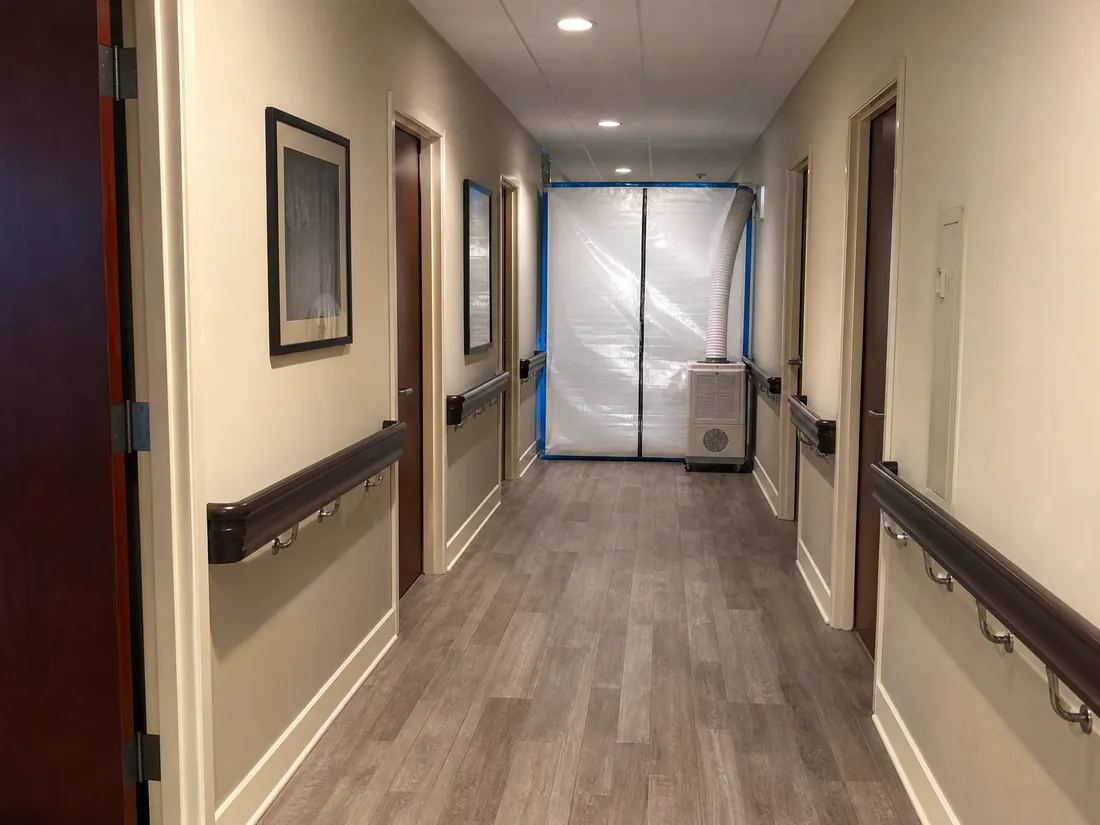
What we do instead is work in small, fully contained zones. One corridor section at a time, negative-pressure containment around any drilling, HEPA filtration, and hard barriers rather than plastic sheeting where residents with dementia might interact with the work area. A job that would take three days in an empty office building takes eight here, and the schedule reflects that in the proposal rather than in a change order.
Infection Control
Facilities with an infection control program will require a risk assessment before construction activity, typically an ICRA, and the resulting requirements govern containment class, air handling, and traffic routing. We do not fight this process. We ask for it at the proposal stage so the containment cost is in the number from the start.
Practical version: dust from core drilling concrete is the primary concern, and it is entirely controllable with wet coring, HEPA vacuum shrouds, and containment. Our techs carry N95s and the crew that does healthcare work is the same three people every time, because familiarity with a facility's protocols is worth more than raw availability.
Testing a 24-Hour Building
Closed-building conditions in a facility that never closes are actually easier than in an apartment complex. HVAC runs constantly and to a standard, windows are typically fixed or restricted, and staff can be briefed. The complications are different: device placement has to account for residents who may move or investigate an unfamiliar object, so monitors go in staff-supervised locations at the required height, and we tell the DON and the maintenance director exactly where each one is.
Resident rooms on slab, dining rooms, activity rooms, therapy gyms, and any ground-floor common area get covered. Basements used for storage generally do not unless staff work down there regularly.
Documentation and Ongoing Monitoring
Healthcare facilities carry documentation burdens no other building type does, and radon documentation gets folded into environment-of-care files, insurer requirements, and, for HUD-financed senior housing, agency program rules. We build the file accordingly: measurement report, mitigation description, verification results, and where required an operation and maintenance plan naming who checks the manometer and how often.
Telemetry monitoring is worth the money in this category more than any other. A fan failure that goes unnoticed for six months in a warehouse is a shrug. In a memory care building, it is a finding.
Cost
Facility testing typically runs $1,400 to $3,600 depending on room count. Mitigation costs run 25% to 60% above the equivalent commercial building because of containment, phasing, and off-hours restrictions; a single-story residential care building that would be $9,000 elsewhere lands closer to $13,000 to $16,000 here. Annual monitoring and service agreements run $700 to $2,000.
Questions About This Service
Can radon mitigation be installed with residents in the building?
Yes, and it routinely is. The work happens in small contained zones with negative pressure containment, wet coring, and HEPA filtration, one corridor section at a time. It takes noticeably longer than the same job in an empty building, which should be reflected in the schedule and the price up front.
Does an ICRA apply to this work?
In facilities with an infection control program, generally yes. We ask for the risk assessment at proposal stage so containment requirements are priced in from the beginning rather than appearing as a change order.
Are senior living facilities required to test for radon?
Not by California statute. Requirements arise from HUD program rules on financed senior housing, insurer conditions, corporate risk policy, and occasionally from families asking questions. Many operators test voluntarily because the occupant population is precisely the one where long-term exposure risk matters least in theory and reads worst in a headline.
How disruptive is the noise?
Core drilling is the only genuinely loud step, roughly twenty minutes per suction point. In residential care we do it mid-morning when residents are typically in activities rather than in rooms, with the affected wing coordinated with the activities director beforehand.
Do you provide ongoing monitoring?
Yes, and we recommend telemetry for this building type specifically. It alerts on fan failure immediately rather than at the next annual check, which matters in a setting where an undocumented gap becomes a survey finding.
Operating a facility that needs testing or mitigation? Call and we will scope it around your residents, not around our calendar.
Call (213) 845-6500