What We Are Usually Chasing
Trichloroethylene and tetrachloroethylene lead the list, the former from metal degreasing and aerospace manufacturing, the latter from dry cleaning. Los Angeles has a century of both. Petroleum hydrocarbons and benzene from former gas stations and the oil fields under the city account for most of the rest.
The industrial corridors tell the story: the Del Amo and Montrose areas in the South Bay, the aerospace legacy sites across the Valley and El Segundo, the plating and machining belt through Vernon, Commerce, and Huntington Park, and former dry cleaners in essentially every commercial strip built before 1990.
Who Regulates This
Inside the City of Los Angeles methane zones, LADBS drives the requirements. Everywhere else, and for chemical contamination generally, the Department of Toxic Substances Control usually takes the lead, sometimes alongside a Regional Water Quality Control Board or a local oversight program.
The practical difference from radon work is enormous. A radon system is done when the verification test passes. A vapor intrusion system enters an operation, maintenance, and monitoring program that can run for years, with periodic sub-slab and indoor air sampling, reporting to the agency, and a defined path to case closure. Budget for the program, not just the installation.
Sampling Before Design
Three sampling media, used in combination:
| Medium | What it tells you | Notes |
|---|---|---|
| Sub-slab soil gas | Concentration directly beneath the building | The primary line of evidence; ports installed through the slab |
| Soil gas (exterior) | Source strength and lateral extent | Often already collected in the Phase II |
| Indoor air | Actual occupant exposure | Confounded by consumer products and building materials; needs a background survey |
Indoor air sampling without a building product inventory produces arguments rather than answers. Nail polish remover, spray adhesive, and a fresh coat of paint will all show up in a summa canister.
How the System Differs From a Radon System
Same core: sub-slab depressurization, sealed penetrations, roofline discharge. The differences that matter:
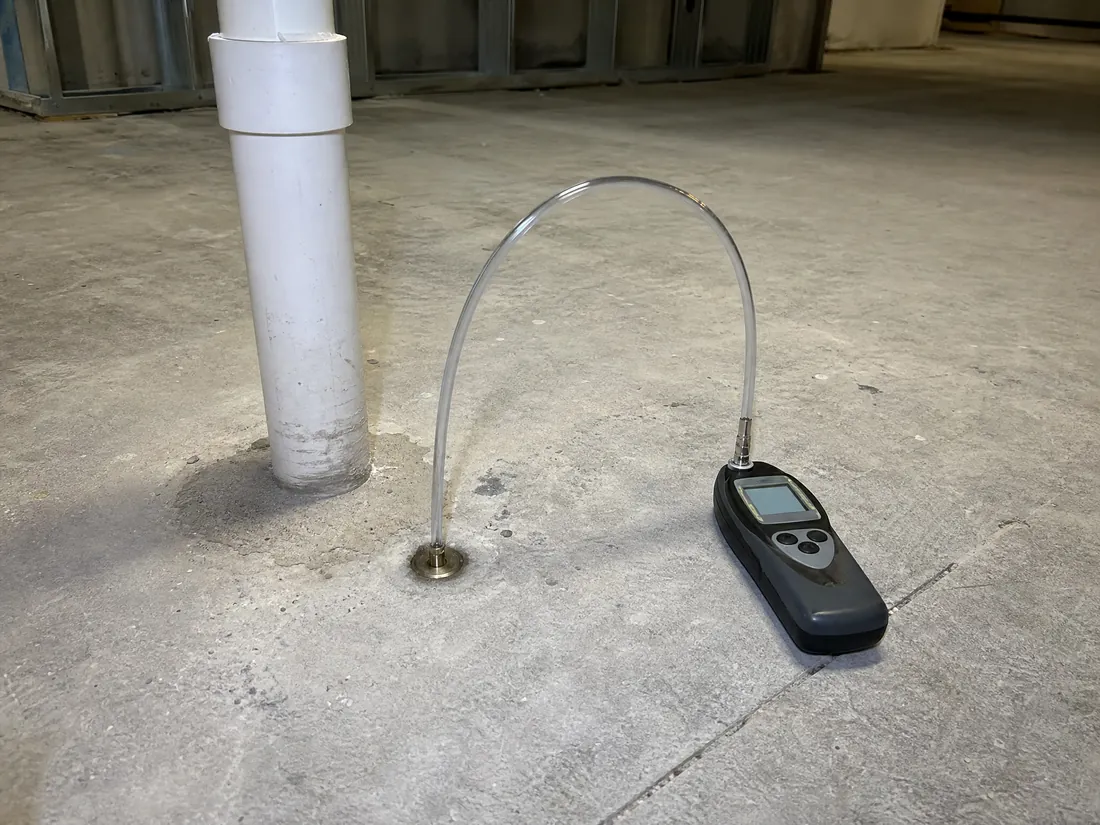
- Permanent sub-slab sampling ports built into the design, so the next monitoring round does not require new core holes in a finished floor.
- Pressure monitoring points across the slab to demonstrate continuous pressure field extension, which the agency will want documented rather than asserted.
- Alarms and telemetry on the fan, frequently required rather than optional.
- Membrane systems for new construction, since a vapor barrier under a new slab is far more effective than anything retrofitted.
- An OM&M plan defining inspection frequency, sampling schedule, reporting, and what constitutes a system failure.
Working With Your Consultant
On most VI projects there is already an environmental consultant of record managing the agency relationship, the sampling, and the risk assessment. We are the contractor who builds and maintains the system, and that division of labor works well. We do not write risk assessments and we do not pretend to; we design and install to the performance requirements the consultant and agency set, and we produce the as-builts and performance data they need for reporting.
If you do not have a consultant yet and are staring at a Phase I with a recognized environmental condition, call anyway. We can tell you what the mitigation end is likely to cost, which is usually the number the deal actually hinges on.
Cost
VI systems typically run 30% to 70% above a comparable radon-only system, because of sampling ports, monitoring instrumentation, alarms, and documentation. A commercial building that would take a $12,000 radon system generally lands $17,000 to $22,000 as a VI system. The OM&M program adds $3,000 to $12,000 a year depending on sampling frequency and agency requirements, and that is the number people forget to budget.
Questions About This Service
What is the difference between radon mitigation and vapor intrusion mitigation?
The pathway and the hardware are the same; the contaminant and the oversight are not. Radon is naturally occurring and the work is done when a verification test reads below 4.0 pCi/L. Vapor intrusion involves chemical contamination, usually falls under DTSC or a water board, and comes with a long-term sampling, monitoring, and reporting program that continues for years toward case closure.
Who regulates vapor intrusion in Los Angeles?
Typically the Department of Toxic Substances Control, sometimes with a Regional Water Quality Control Board or a local oversight program. Inside City of Los Angeles methane zones, LADBS requirements also apply and are enforced through the building permit rather than an environmental case.
How much does vapor intrusion mitigation cost?
Roughly 30% to 70% more than an equivalent radon-only system, so a building needing a $12,000 radon system typically runs $17,000 to $22,000 as a VI system. The ongoing operation, maintenance and monitoring program adds $3,000 to $12,000 annually, which is the line item people most often leave out of a pro forma.
Can one system handle radon, VOCs and methane?
Frequently yes, and designing it that way from the start is far cheaper than sequential systems. The design has to satisfy the most stringent applicable requirement, which in the City of Los Angeles is usually the methane code, since Division 71 carries prescriptive component and inspection requirements the others do not.
Do we need this before we can get a certificate of occupancy?
In a methane zone, absolutely: LADBS will not issue a certificate of occupancy without completed methane mitigation. On a DTSC case, occupancy conditions are set by the agency and the specific case, and they vary enormously. Ask early.
Phase I flagged a REC, or DTSC has an eye on your site? Call and we will scope the mitigation end of it.
Call (213) 845-6500