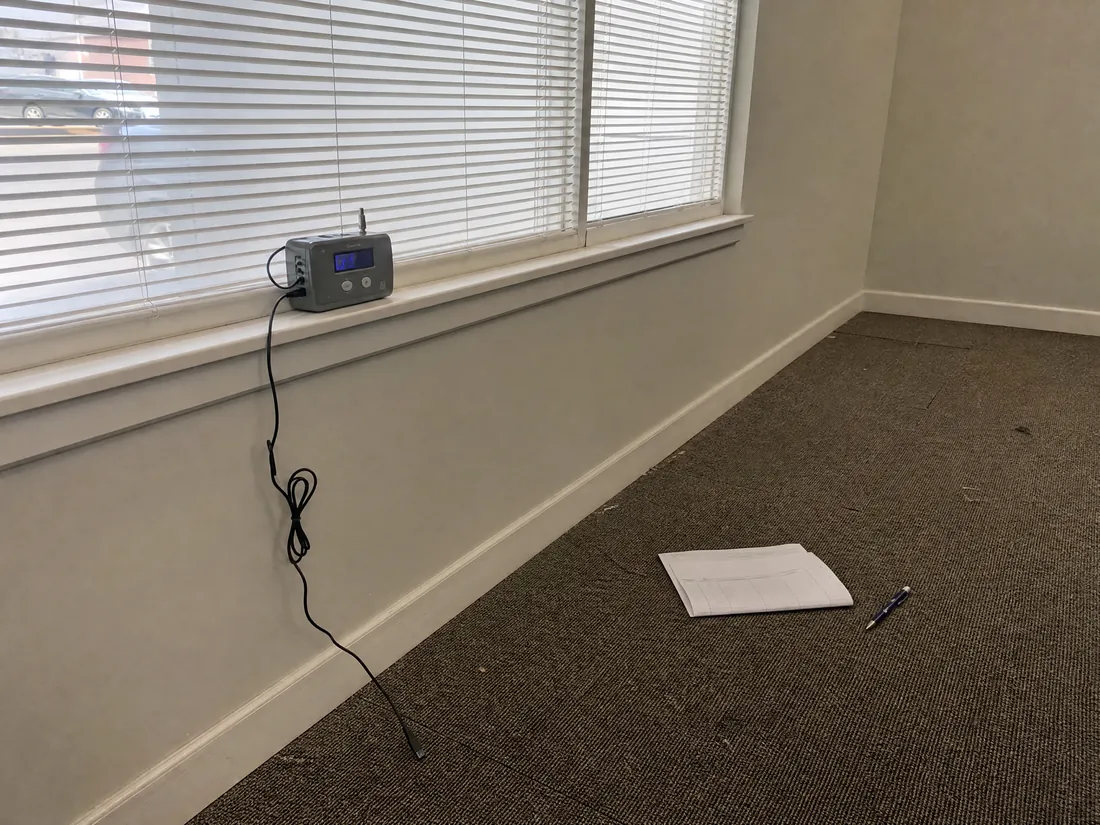
Timing
The test starts no sooner than 24 hours after the system is energized and operating normally, so the building has time to reach a new equilibrium. Testing immediately after startup produces a number that reflects the transition rather than the steady state, usually in a flattering direction, which is exactly why the waiting period exists.
The measurement itself runs 48 to 96 hours with a continuous monitor under closed-building conditions. On buildings where seasonal variation is a live question, or where an agency requires it, a long-term follow-up with alpha track detectors runs alongside or afterward.
Where the Devices Go
In the same locations that tested elevated originally, at minimum. This is the point people try to negotiate and should not: retesting a different room proves nothing about the room that had the problem. Where the original elevated result was in a unit whose tenant has since moved out and the unit is being renovated, we test it anyway and note the condition.
On larger mitigations we also place devices in a sample of previously clean ground-contact spaces, because a mitigation system changes building pressure relationships and, rarely, moves the problem rather than solving it.
What Passing Means
Below 4.0 pCi/L in every tested space. That is the action level used by EPA, CDPH, HUD, and every agency policy we encounter, and there is no partial credit or averaging across rooms.
Our own bar is lower. If a verification comes back at 3.7 pCi/L we will tell you it passed and also tell you it is closer to the line than we like, because a result that marginal will move with the season and the next test may not be as kind. Usually a fan upsize or one additional suction point takes it to 1.5 and removes the question permanently.
If It Does Not Pass
We come back. On a system we installed, that is at our cost, and it is written into the contract rather than promised on a phone call.
The diagnostic sequence is: verify the fan is performing to curve, re-run communication testing to see whether the pressure field is reaching where we thought, smoke test penetrations and any suspicious floor features, then add suction points or resize the fan. The Glendale medical office where the culprit turned out to be a tiled-over darkroom floor drain is the reason smoke testing moved earlier in that sequence for us.
The Report
What a lender's environmental professional, a school board, or a buyer's consultant needs in the document: pre-mitigation results for comparison, description of the installed system including fan model and suction point count, system startup date, verification device serials and calibration dates, deployment and retrieval timestamps, building conditions during the test, results by location, and a signature from a CDPH-listed professional.
We produce that as a single PDF, and we will send it directly to the consultant, lender, or escrow if that saves a round trip. It usually does.
Cost
Verification testing typically runs $350 to $700 for a single building and is included in our mitigation contracts rather than billed separately. Standalone verification on a system installed by someone else runs $450 to $900 depending on device count and turnaround. Multifamily post-mitigation testing across multiple previously elevated units is priced per unit at $45 to $110, the same as initial testing.
Questions About This Service
When can post-mitigation testing start?
No sooner than 24 hours after the system is energized and running normally, so the building reaches equilibrium. The test itself then runs 48 to 96 hours with a continuous monitor under closed-building conditions.
What result counts as passing?
Below 4.0 pCi/L in every tested location. There is no averaging across rooms and no partial credit.
What if the system does not pass?
On a system we installed, we return at our cost and modify it: verify fan performance, re-run communication testing, smoke test penetrations, then add suction points or resize the fan as the diagnostics indicate. That obligation is in our contract, not just in a conversation.
Do you have to test the same rooms that were elevated before?
Yes, at minimum. Testing different rooms proves nothing about the spaces that had the problem. On larger jobs we also sample previously clean ground-contact spaces, because mitigation changes building pressure relationships.
Who has to sign the verification report?
A professional listed by the California Department of Public Health for radon measurement. For lender-driven work, the reviewer will check that the signature and the credential match, so confirm the individual is listed rather than assuming the company's listing covers whoever showed up.
How much does post-mitigation testing cost?
$350 to $700 for a single building, and it is included in our mitigation contracts. Standalone verification on someone else's system runs $450 to $900.
System installed but never verified? That gap will surface in your next transaction. Call and close it.
Call (213) 845-6500