What Actually Fails
In order of how often we see it:
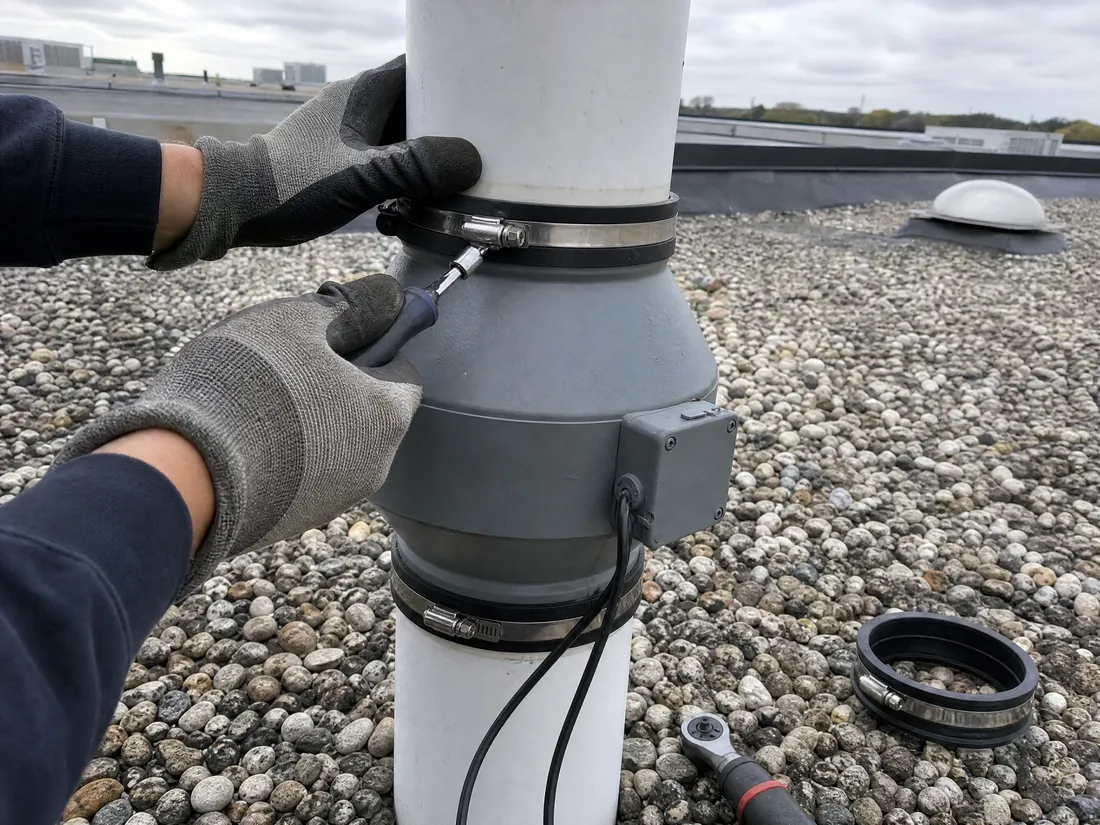
- Fan motor failure. Commercial radon fans run continuously and typically last 8 to 12 years. They fail without drama.
- Condensate blockage. Pipe that was not sloped back to the suction point collects water at a low spot and slowly chokes the airflow. Common on retrofit systems where somebody routed pipe around an obstacle.
- Broken seals. Slab movement, subsequent trades cutting into a sealed penetration, or somebody's sump lid pried off and left loose.
- Disconnected power. An electrician working on a panel kills the circuit for the day and does not turn it back on. We find this at least twice a year.
- Physical damage. Forklifts, roofers, landscapers with string trimmers, and one memorable delivery truck.
Fan Replacement
We keep RadonAway RP265 and GP501 fans and Fantech commercial inline units on the shelf, which means most replacements happen within a few days rather than after a two-week lead time. A straight swap on an accessible fan is typically $850 to $1,600 including labor and a verification check; roof-mounted units and anything requiring a lift run higher.
When we replace a fan we re-verify the system rather than assuming the new fan does what the old one did. Sub-slab conditions change over a decade, and occasionally a replacement is the moment we discover the system was marginal from day one.
Service Agreements
An annual or semi-annual agreement covers manometer verification and photo documentation, fan operation check and amp draw, visual inspection of piping, penetrations and discharge, seal inspection at accessible points, and a written service record for your files. Retesting is separate and scheduled to whatever interval your lender, district, or OM&M plan requires, commonly every two years for radon and annually or more frequently for regulated vapor intrusion systems.
Pricing runs $450 to $1,600 a year depending on system count and site complexity. Portfolios get a route rate; we would rather do eleven properties in one week than one property eleven times.
Telemetry, and Who It Is Actually For
Remote monitoring puts a sensor on the system that reports fan status and pressure continuously and sends an alert when something changes. It costs more per system per year than most owners want to pay, and for a lot of buildings a semi-annual manometer check is genuinely sufficient.
Where it earns its keep: healthcare and senior living, schools, any building under an active regulatory OM&M requirement, and portfolios large enough that nobody will reliably walk every system twice a year. If you own three buildings and someone competent walks them, save your money. If you own thirty, buy the telemetry.
Systems Other People Installed
About a third of our service work is on systems we did not build, and we will happily take them on. What we will not do is put our name on a system that cannot pass verification without telling you so in writing.
The recurring find on inherited systems, and this is a real gripe: risers terminated below the roofline or within a few feet of a rooftop intake, because whoever installed it did not want to deal with the roofer. That discharge routing is not a technicality. It puts soil gas back into the outdoor air the building is drawing in, and we have measured it doing exactly that.
Questions About This Service
How long does a commercial radon fan last?
Typically 8 to 12 years of continuous operation. They fail silently, which is why the manometer check matters.
How do I know if my radon system is working?
Look at the u-tube manometer on the riser. If the colored liquid sits at different heights in the two legs, the fan is pulling and the system is operating. If the two sides are level, the fan is not running. Check it twice a year and note the level against the mark made at commissioning.
What does fan replacement cost?
Generally $850 to $1,600 including labor and a post-replacement verification check, higher for roof-mounted units or anything needing a lift. We stock the common commercial fan models so the wait is usually days rather than weeks.
How often should a commercial building be retested after mitigation?
Every two years is the common interval for radon systems, and it is what most lender O&M plans specify. Regulated vapor intrusion systems under agency oversight usually require annual or more frequent sampling per the approved monitoring plan. Retest also after any significant HVAC change, building renovation, or system service.
Do you service systems installed by other companies?
Yes, roughly a third of our service work. We will assess the existing system honestly, including telling you in writing if it was installed in a way that cannot pass verification. The most common defect we find on inherited systems is discharge terminated below the roofline or too close to a rooftop air intake.
Is remote monitoring worth it?
For healthcare, senior living, schools, buildings under a regulatory monitoring requirement, and portfolios too large to walk reliably, yes. For an owner with a few buildings and competent maintenance staff, a semi-annual manometer check does the same job for far less money.
System that nobody has looked at in years? Call and we will check it before your next test does it for you.
Call (213) 845-6500