Where This Applies in Los Angeles
Plenty of LA commercial property predates slab-on-grade construction: 1920s and 30s storefronts along Colorado Boulevard and Ventura Boulevard, older office conversions in Highland Park and Eagle Rock, small medical and professional buildings all through the older parts of Pasadena and Glendale, and a good deal of converted residential stock now operating as offices, clinics, and childcare.
These buildings also tend to sit in the hillside-adjacent areas where LA's genuinely elevated radon readings cluster, which is not a coincidence worth ignoring.
The Membrane Is the Whole Job
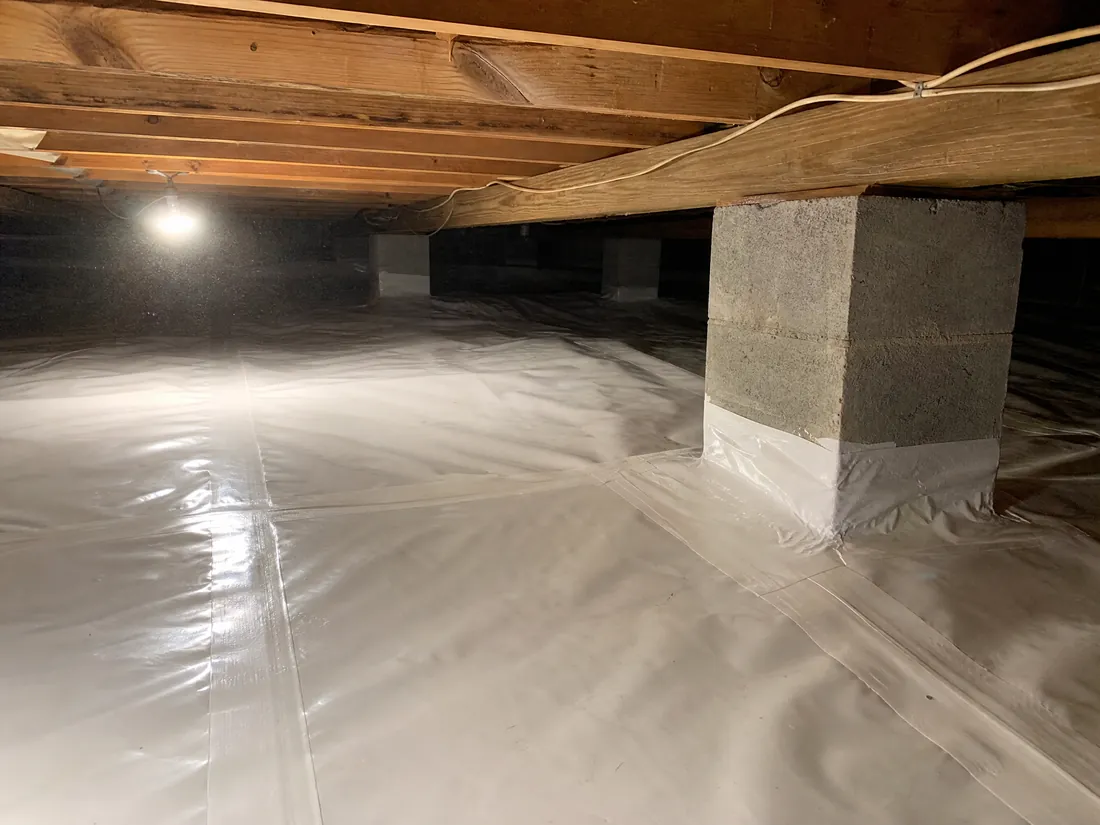
A sub-membrane system succeeds or fails on the seal, and there is far more of it than people expect. Reinforced polyethylene, minimum 6-mil and generally heavier for commercial work, laid across the entire crawl space floor, seams overlapped and sealed, edges run up the stem wall and mechanically fastened, and every pier wrapped and sealed individually.
Piers are where these systems leak. A crawl space with 40 piers has 40 potential failures, and taping around a pier is the tedious, on-your-back, headlamp-and-knee-pads part of the job that separates a system that pulls a real vacuum from one that just moves crawl space air around. Efrain does most of ours and he is genuinely faster at it than anybody I have hired since.
The Moisture Side Benefit Nobody Asks About
Here is what actually sells this work in Los Angeles, where radon is often marginal: the same sealed membrane that controls soil gas also stops ground moisture, which is the single biggest driver of crawl space wood rot, mold growth, and the musty smell that follows the HVAC return air up into your tenant space.
We have installed sub-membrane systems where the radon result was 3.2 pCi/L, technically under the action level, and the owner proceeded anyway because the crawl space had standing water every February and the ground-floor tenant kept complaining about odor. Both problems solved by the same membrane.
Sizing and Fan
Sub-membrane systems generally need less fan than sub-slab systems, because a sealed membrane offers far less resistance than compacted earth. A single suction point under the membrane usually serves the whole crawl space if the membrane is properly sealed. If it is not, no fan on the market fixes it.
The riser exits through a rim joist or up an exterior wall to a fan mounted outside, discharge above the roofline. Interior routing is possible but rarely necessary on this building type.
Cost
Commercial sub-membrane systems run $12 to $22 per square foot of crawl space, driven mostly by pier count, headroom, and how much debris has to come out before anything can be laid down. A 1,600 square foot crawl space under a small professional building typically lands between $19,000 and $32,000. Crawl spaces with under 24 inches of clearance cost more because the labor is brutal.
Debris removal, old ductwork, and standing water are handled before membrane work begins and are quoted separately, because we have opened enough crawl spaces to know that what is down there is never what the owner described.
Questions About This Service
What is sub-membrane depressurization?
A sealed plastic membrane laid across a crawl space floor with a fan pulling soil gas from underneath it and venting it above the roofline. It is the crawl space equivalent of sub-slab depressurization, and it is the correct method for any building on a raised foundation.
How much does crawl space radon mitigation cost?
Commercial work runs roughly $12 to $22 per square foot of crawl space. A 1,600 square foot crawl space typically lands between $19,000 and $32,000, with pier count, headroom, and debris removal driving the variation.
Does it help with moisture too?
Yes, and in Los Angeles that is often the stronger reason to do it. The sealed membrane blocks ground moisture, which is the primary driver of crawl space rot, mold, and the musty odor that ends up in ground-floor tenant space through HVAC returns.
Can you work in a low crawl space?
Down to about 18 inches, yes, though the labor cost rises steeply below 24 inches. Anything shallower generally requires excavation or a different approach entirely, which we will tell you before quoting.
What about the existing crawl space vents?
In a sub-membrane system the vents typically stay. The membrane isolates the ground rather than the air, so venting the crawl space air is not in conflict with the system. Sealing vents becomes a question only in encapsulation projects, which is a different scope with different code implications.
Building on a raised foundation? Call and we will get someone under there with a headlamp before quoting.
Call (213) 845-6500