Why Big Slabs Are Often Easy
A 1990s tilt-up in Vernon, Commerce, or Rancho Dominguez was almost certainly poured over a compacted aggregate base designed to drain. Aggregate that drains water also moves air, which means a single suction point can develop a measurable pressure field 50 to 70 feet out in every direction. Sixty thousand square feet under two or three points is a routine result.
Older masonry industrial buildings from the 1940s and 50s, of which the eastern industrial corridor has plenty, behave completely differently. Slabs poured on native soil with no base course communicate poorly, and we have seen buildings needing a point every 1,200 square feet. Age of the slab tells you more about the price than the size of it does.
Routing Around a Working Building
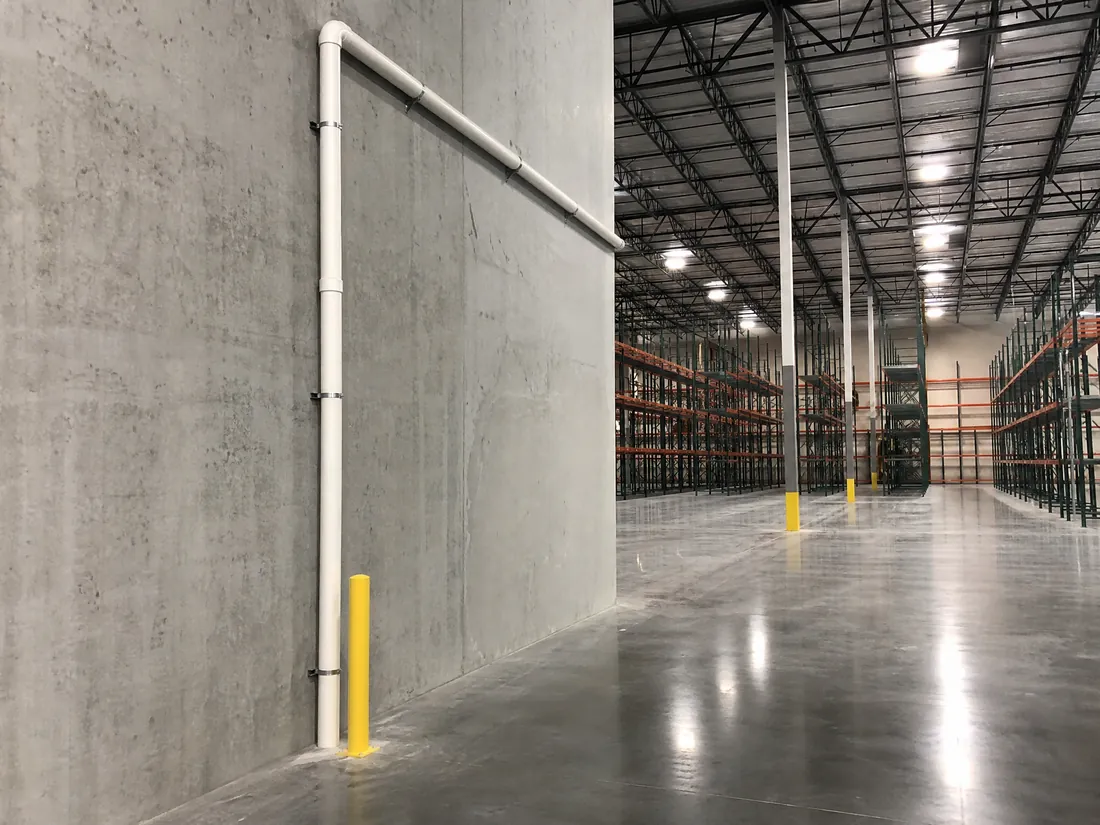
Every riser below about 12 feet gets protected. Bollards at floor level in traffic areas, steel sleeves where pipe passes near dock doors, and horizontal runs kept above racking height or tight along a wall where nothing turns. We have replaced enough pipe hit by forklifts on other people's systems to be firm about this.
Discharge goes above the roofline, away from make-up air units and swamp coolers. On buildings with translucent panel roofs, which show up on a lot of older LA industrial stock, penetration detailing matters more than usual and we bring in a roofer who will warranty the flashing rather than doing it ourselves and hoping.
Radon Is Frequently Not the Only Gas
Industrial property in Los Angeles carries history. Metal plating, machine shops, printing, dry cleaning, and fuel handling all leave chlorinated solvents in soil, and those follow the same pathway into the building as radon does. If your site has a Phase I with a recognized environmental condition, or sits near the Del Amo or Montrose areas in the South Bay, the mitigation system should be designed for both from the start.
A combined system costs meaningfully less than two sequential ones, and the design differences are real: vapor intrusion systems under DTSC oversight typically require more monitoring points, sub-slab sampling ports built into the system, and long-term operation and maintenance documentation that a radon-only system does not. More on vapor intrusion work.
Cold Storage, Food, and Clean Manufacturing
Cold storage buildings are their own problem. Under-slab heating systems designed to prevent frost heave, vapor barriers under the slab, and sealed envelopes change the pressure picture completely, and drilling into a cold storage slab is not something to do casually. Food facilities bring sanitation requirements that govern how pipe is mounted and what it is made of, and we have had to run stainless-clad sections in wash-down zones more than once.
Tell us the operation on the first call. It changes the design more than the square footage does.
Cost
A modern tilt-up of 40,000 to 80,000 square feet with good communication generally runs $9,000 to $18,000 for a complete system. Older masonry industrial buildings of the same size can double that on point count alone. Testing an industrial building is inexpensive, usually $700 to $1,600, because the occupied-space device count is low even when the building is enormous.
Questions About This Service
How many suction points does a warehouse need?
Often just two or three for 60,000 square feet, if the slab was poured over a proper aggregate base. Older slabs on native soil can need one every 1,200 square feet. Communication testing on your actual slab is the only way to know, and it is the first thing we do.
Will the piping interfere with our racking and forklifts?
Not if it is designed properly. We route above racking height or tight to walls, sleeve and bollard anything within reach of traffic, and coordinate the layout with your operations manager before installation rather than after.
Can you work without shutting down operations?
Yes. Core drilling is scheduled for off-shift hours; everything else can proceed alongside normal operations with a work area coned off.
Our site has a Phase I with a REC for solvents. Does that change the system?
Considerably. A vapor intrusion system under DTSC oversight needs sub-slab sampling ports, more extensive monitoring, and an operation, maintenance and monitoring plan that outlives the installation. Designing for both radon and VOCs from day one costs far less than retrofitting a radon-only system later.
What does industrial radon mitigation cost?
$9,000 to $18,000 for a typical modern tilt-up of 40,000 to 80,000 square feet. Older masonry buildings with poor sub-slab communication can run double that because of point count.
Industrial building with a soil gas question? Call and we will bring the diagnostic gear out before anyone writes a number down.
Call (213) 845-6500