The Design Sequence
- Communication testing. Drill small test holes, apply vacuum at a candidate location, measure the pressure field at increasing distances with a micromanometer. This produces the extension radius, which sets point count.
- Suction point layout. Points placed so their pressure fields overlap and cover all occupied slab area, positioned where pipe can actually be routed and where drilling will not hit post-tension cables, structural elements, or in-slab utilities. We scan before we drill, every time.
- Pit excavation. Material is removed from under the slab at each point, typically 5 to 15 gallons, to create a plenum. Skipping this is the most common corner cut in the industry and it cripples system performance.
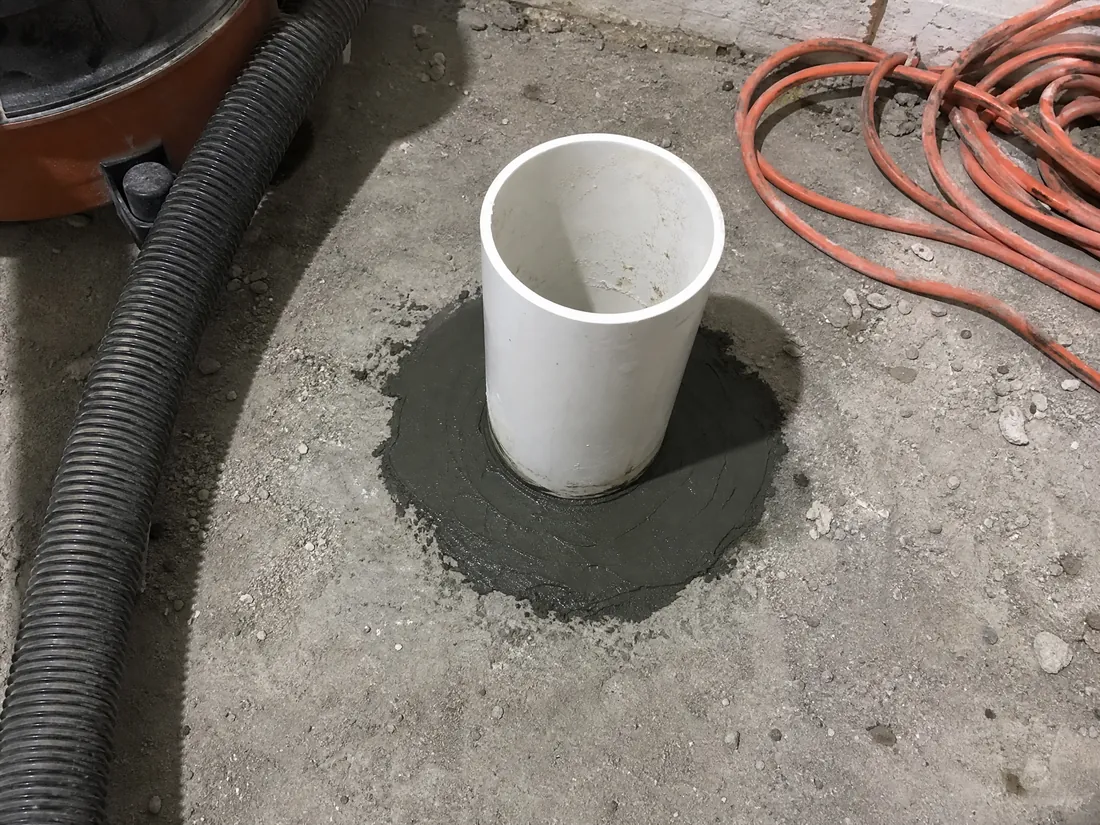
- Piping. Schedule 40 PVC, sized for the flow, sloped to drain condensate back to the pit, sealed at the slab penetration with polyurethane.
- Fan selection. Matched to the system curve, not picked off a shelf. High-suction low-flow fans for tight soils, high-flow low-suction for permeable aggregate. Getting this backwards produces a system that hums and does nothing.
- Discharge. Above the roofline, above and away from operable windows and air intakes per the standard.
- Monitor and label. A u-tube manometer where someone will see it, plus a label explaining what a normal reading looks like.
Fan Selection, In Plain Terms
Two variables: how much air the system can move, and how hard it has to pull to move it. Soil under a slab poured over clean aggregate offers little resistance, so you want a fan that moves a lot of air at low static pressure. Soil that is compacted clay offers enormous resistance, so you need a fan that generates high vacuum even when almost nothing is flowing.
We stock RadonAway RP265 and GP501 units and Fantech commercial inline fans in the shop off Slauson, which covers most of what LA slabs demand. Anything larger gets a proper commercial blower and a disconnect. Fans are mounted outside the occupied envelope, always, so a cracked housing leaks soil gas outdoors and not into the building.
Reading a Manometer
Every system we install has a u-tube manometer on the riser. It is a plastic tube with colored liquid in it. When the fan is working, the liquid sits at different heights in the two legs; when the fan fails, the two legs equalize. That is the whole diagnostic, and it takes three seconds.
We mark the normal operating position with a line at commissioning. If your maintenance staff can be taught one thing about the system, teach them that: liquid level, twice a year, and call if the two sides are even.
Noise and Energy
A properly mounted commercial fan is audible up close and inaudible inside the building. Noise complaints trace almost always to a fan mounted on a wall shared with occupied space, transmitting vibration through structure. We mount to grade-level pads or roof curbs with isolation wherever a wall mount would be adjacent to occupied space.
Energy draw is 60 to 180 watts continuous per fan, roughly $90 to $260 a year at LA commercial rates. It runs 24/7. A system on a timer is not a system.
Where SSD Is the Wrong Tool
Buildings on crawl spaces get sub-membrane depressurization instead, because there is no slab to depressurize under. High-rise offices with capable air handlers are often better served by building pressurization. And a building where the elevated reading traces to a specific penetration, an open sump, or a shaft, may need sealing rather than a system.
Any contractor whose answer to every building is the same system is not diagnosing, they are selling.
Questions About This Service
What is sub-slab depressurization?
A fan-powered system that keeps the area under a building's floor slab at a slightly lower pressure than the occupied space above, so soil gas including radon flows out through sealed piping and vents above the roof instead of entering the building. It is the standard method for radon, methane, and VOC vapor control in slab buildings.
How many suction points will my building need?
Somewhere between one and dozens, determined by communication testing on your actual slab. A modern slab over clean aggregate might develop a 60-foot pressure field from one point; an old slab on native clay might reach 12 feet. That single measurement drives most of the price.
Is the fan loud?
Not inside the building when it is mounted correctly. Complaints almost always come from fans bolted to a wall shared with occupied space, which transmits vibration. We use pads, curbs, and isolation mounts for that reason.
Can the fan be turned off at night to save energy?
No. The system depends on maintaining a continuous pressure differential; cycling it lets soil gas re-enter and invalidates the mitigation. It draws 60 to 180 watts, which is roughly a light bulb.
How do I know it is still working?
Check the u-tube manometer on the riser. If the liquid in the two legs sits at different heights, the fan is pulling. If they are level, the fan has failed and you should call. Twice a year is a reasonable check interval, and telemetry monitoring is available where somebody needs to know the same day.
How long do these systems last?
The piping and sealing last indefinitely. Fans are the wear item and typically run 8 to 12 years of continuous operation before failure. Replacement is a couple of hours and considerably cheaper than the original install.
Want to know what your slab would actually need? Call and we will run communication testing before quoting anything.
Call (213) 845-6500