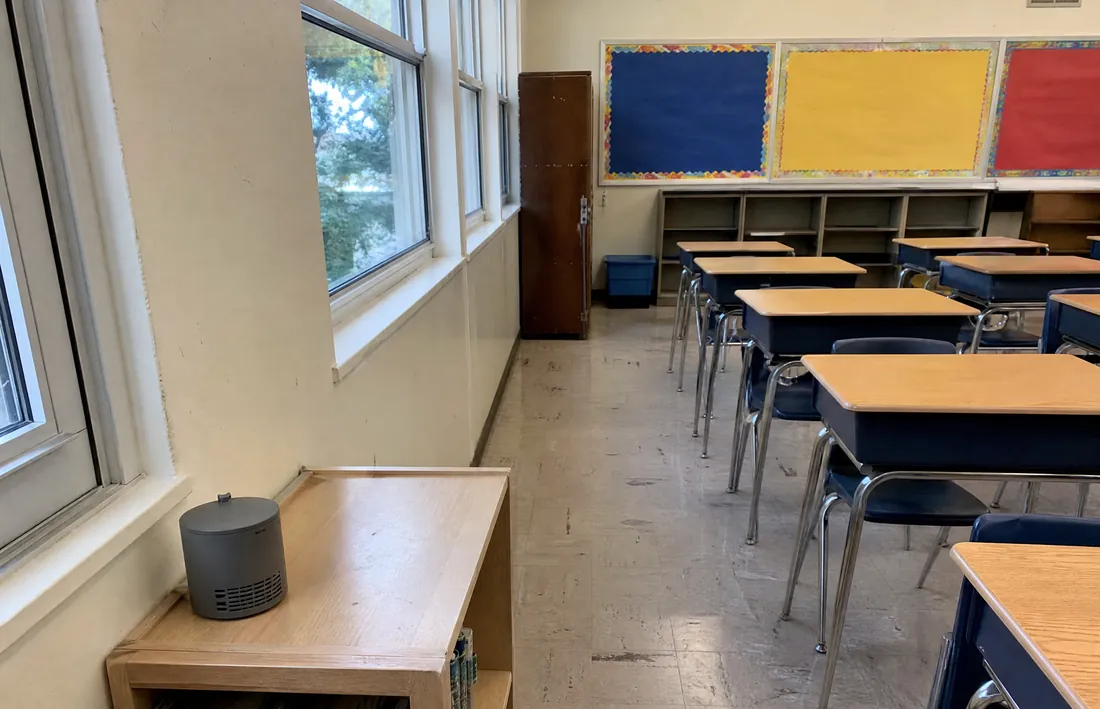
Why Schools Test Differently
A classroom is a mechanically ventilated box with 25 people breathing in it, and the ventilation is doing something to slab pressure every hour of the day. Unit ventilators, rooftop packaged units, and older univents with tired dampers all shift the building's pressure relationship with the ground. That is why a single campus-wide number is meaningless: the room next to the boiler and the room at the end of the wing over the same slab can differ by a factor of three.
ANSI/AARST RMS-LB, the mitigation standard written for schools and large buildings, exists precisely because of this. It treats HVAC as part of the mitigation system rather than an obstacle to it, and it requires the level of documentation an institution needs.
Testing Around a School Calendar
Here is the tension nobody warns you about: valid testing needs the building operating under normal, closed conditions, which means school in session. Loud mitigation work needs the building empty, which means breaks. So the sequence almost always runs test in session during a cool-weather stretch, diagnose immediately after, and install over the next break.
We plan campus work a term ahead for this reason. A test in early December and an install over winter break is our most common school timeline; the second most common is test in February, install over spring break.
Childcare and Preschool
Licensed childcare facilities get more scrutiny than K-12 in practice, mostly because parents ask and because the occupants are small children who spend the day at floor level where radon concentration is marginally higher. Our approach in a childcare center is to test every ground-contact activity room and nap room rather than sampling, because the room count is small enough that sampling saves almost nothing and creates questions.
Mitigation on a Campus
Three routes, usually in combination:
- HVAC adjustment first. If rebalancing outdoor air on an existing system will hold the ground floor slightly positive, that is the cheapest and least invasive fix available, and often the only one required in a mild LA climate where systems are not fighting a Chicago winter.
- Sub-slab depressurization per wing. Bungalow and finger-plan campuses get a system per building, exterior risers, fans on the roof or a screened exterior wall away from playground areas.
- Sealing. Never sufficient alone, always worth doing: expansion joints, utility penetrations, and the trench drains in older multipurpose rooms.
Fan placement on a school is worth arguing about. We keep discharge points away from operable classroom windows and outdoor air intakes by a wide margin, and we do not put fans where a curious middle schooler can reach them.
Reporting to People Who Are Not Engineers
The deliverable a school actually needs is two documents: the technical report with device data, protocol, and room-by-room results, and a one-page plain-language summary the head of school or the facilities director can hand to a board or post for parents without translating it themselves. We write both. The summary says what was tested, what was found, what the action level means, and what is being done, in language that does not require a physics background.
Cost for a Campus
Testing a 30-classroom campus with ground-contact rooms typically runs $2,200 to $4,800 depending on room count and whether continuous monitors or long-term devices are used. Mitigation, where needed, is priced per building: $8,000 to $18,000 per wing is the usual band, and HVAC-only solutions where they work are dramatically cheaper, sometimes just a balancing contractor's invoice.
Questions About This Service
Are California schools required to test for radon?
No. There is no California statute requiring radon testing in schools. Testing here is driven by district policy, private school boards, insurers, childcare licensing expectations, and parent inquiry. The EPA recommends all schools be tested regardless of state requirements.
When during the year should a school be tested?
During session, under normal closed-building operation, ideally in a cooler stretch when windows stay shut. In Los Angeles that means roughly November through March. Testing during summer session in an open building produces numbers nobody should rely on.
Do you test every classroom or a sample?
Every ground-contact room that is regularly occupied. Upper-floor rooms over occupied space below are generally excluded. For a typical campus that means all first-floor classrooms, the library, offices on slab, and any below-grade space staff use.
Can the work be done without disrupting instruction?
Testing, yes, entirely. Mitigation involves core drilling that is genuinely loud for about twenty minutes per suction point, so that gets scheduled for breaks, weekends, or evenings. Pipe routing and fan installation are quiet enough to do during school hours in most buildings.
What does it cost to test a school campus?
Roughly $2,200 to $4,800 for a 30-classroom campus, driven by the number of ground-contact rooms and the device type.
What happens if one classroom is elevated?
That room is closed off from a testing standpoint, retested for confirmation if the schedule allows, and if confirmed, mitigation follows for the slab section serving it. We do not recommend relocating instruction over a single short-term result before confirmation, and we say so in writing, because the confirmation frequently comes back lower.
Planning a campus test this school year? Call and we will map it to your calendar.
Call (213) 845-6500