Where the Requirements Stand in 2026
Short version: there is no longer one universal number.
The 2023 Enterprise Multifamily Radon Policy standardized testing at 25% of ground-contact units with at least one test per building. On March 26, 2025, FHFA rescinded the directive behind it. Fannie Mae responded by removing the fixed schedule, leaving scope to the environmental professional based on property type, local geology, and any state or local requirements. Freddie Mac kept a floor but lowered it to 10% of ground-contact units with a minimum of one test per building, applied where the consultant concludes testing is warranted. HUD and FHA multifamily programs continued on their own track and still require testing under ANSI/AARST protocols with a 4.0 pCi/L action level.
What this means for an LA owner: the consultant's professional judgment now carries the weight that a rule used to. In a low-radon county like ours that can mean less testing than a Denver property would face, but it is not a free pass, and it varies by lender and by deal. Full breakdown of the agency rules.
Which Units Count
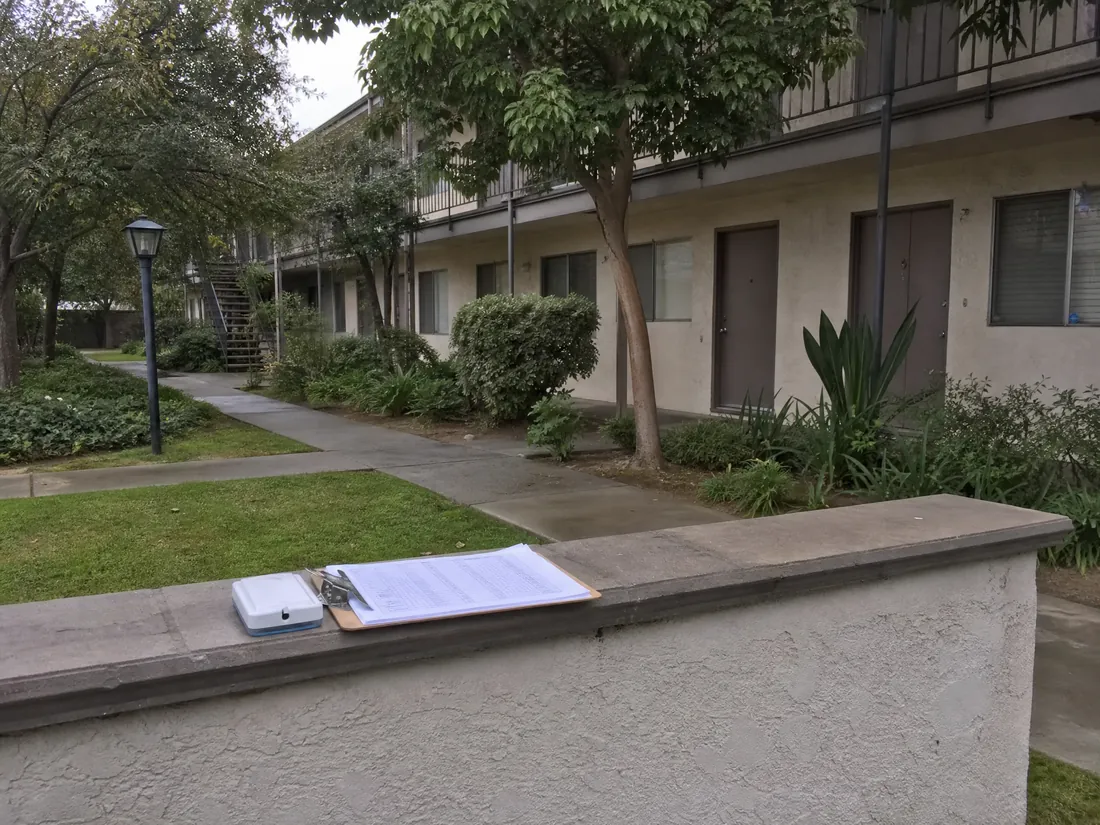
Ground-contact units. A unit is ground-contact if any occupied portion sits on or below grade: slab-on-grade first floors, units over a crawl space, units partially below grade on a sloped site, and units above an enclosed sub-grade garage. Second-floor units over open breezeway generally are not.
On a typical 1970s South Bay garden property this works out to somewhere between a third and a half of the doors. On a podium building over subterranean parking, the entire first residential level counts. Get this classification right before you price anything, because it is the difference between testing 14 units and testing 40.
Tenant Access, Which Is the Real Project
Nobody's schedule slips because of physics. It slips because of unit access. Our standard approach:
- We draft the resident notice and hand it to your management for distribution, in English and Spanish, at least 48 hours ahead, with a plain explanation of what the device is and what it is not.
- Deployment happens in one pass with a staff escort, typically a morning for 30 to 40 units.
- Devices sit 48 to 96 hours. Residents are asked to keep windows closed and not move the monitor. Some will anyway; continuous monitors let us see it.
- Retrieval in a second pass, same escort, missed units rescheduled that week.
One quirk worth knowing: we schedule Monday through Thursday deployments almost exclusively, because a Friday deployment means a weekend of open windows and a data set full of dips.
If Units Test Elevated
Mitigation is per slab, not per unit. A single building with four elevated units usually gets one system serving that building, not four systems. That is why the per-unit numbers people quote are misleading in both directions.
Industry modeling published through AARST in 2025 put mitigation at roughly $2,400 to $4,000 per affected unit, which on a 155-unit example property worked out to about $387 to $645 per unit spread across the whole asset. Our LA experience tracks that: per-building systems on garden properties run $7,000 to $14,000 each, and podium buildings are usually one larger system with points in the garage slab.
After mitigation, every previously elevated unit gets a verification test, and the results go into the same report format the lender already accepted.
Documentation Your Lender's Consultant Will Actually Accept
The report needs: the protocol named, the ground-contact unit determination and how you arrived at it, device serials and calibration, deployment and retrieval timestamps, unit-by-unit results, building conditions, mitigation description where applicable, post-mitigation verification results, and a signature from a CDPH-listed professional. If an operations and maintenance plan is required, that gets written too.
We deliver directly to your environmental consultant when that shortens the chain, which it usually does.
What This Costs on a Real Property
| Property | Testing | If mitigation is needed |
|---|---|---|
| 24 units, 2 buildings, all slab | $1,100–$2,000 | $7,000–$14,000 per affected building |
| 88 units, 6 buildings, garden style | $2,400–$4,500 | $7,000–$14,000 per affected building |
| 210 units, podium over garage | $3,000–$6,500 | $18,000–$40,000 single larger system |
Testing ranges assume continuous monitors and standard turnaround; rush work adds. Mitigation ranges assume typical LA sub-slab communication and are confirmed by diagnostics before contract.
Questions About This Service
Is radon testing still required for a Fannie Mae multifamily loan in 2026?
It depends on the deal now rather than on a fixed rule. FHFA rescinded the 2023 directive in March 2025, and Fannie Mae removed the fixed 25% ground-contact-unit schedule from its guide, leaving the scope to the environmental professional based on property type, geology, and local requirements. Freddie Mac retained a lower floor of 10% of ground-contact units with at least one test per building where its consultant concludes testing is warranted. HUD and FHA multifamily still require it under their own program rules. So the practical answer is: ask your lender and your Phase I consultant early, because in a low-radon county like Los Angeles the scope can be modest, and finding out three weeks before closing is what causes problems.
What is a ground-contact unit?
Any unit with occupied space on or below grade: slab-on-grade first floors, units over crawl spaces, partially below-grade units on a sloped lot, and residential floors sitting directly over an enclosed subterranean garage.
How much does multifamily radon testing cost per unit?
Generally $45 to $110 per unit tested in the Los Angeles area, with the per-unit price falling as the count rises because deployment and retrieval are a single mobilization either way. A 24-unit property might run $1,100 to $2,000 all in; a 210-unit podium property $3,000 to $6,500.
Do tenants have to leave their apartments?
No. Residents stay in place the entire time. They get a notice asking them to keep windows closed and leave the small device alone for the two to four days it sits there.
What if a resident refuses access?
It happens on nearly every property. We document the refusal, substitute another ground-contact unit in the same building where the standard allows it, and note the substitution in the report so the consultant sees the reasoning rather than a gap.
Can you test and mitigate before we close?
Usually. Our fastest complete cycle on a closing deadline was nine days from first call to signed post-mitigation verification, on a 40-unit property in Long Beach. It required weekend work and a rush lab, both of which cost extra and both of which were cheaper than an extension.
Deal under contract with radon in scope? Call with the unit count and the closing date and we will tell you today whether it fits.
Call (213) 845-6500